
If you’ve heard the term “killer bees” and wondered whether they’re a real concern in the Phoenix area, the answer is yes. Africanized bee removal in Phoenix is one of the most common calls we receive, and for good reason: Africanized honey bees have been established in Arizona since 1993 and are now found throughout Maricopa County. Understanding what they are, how they behave, and what to do if you find a nest on your property can protect your family, your pets, and your home.
What Are Africanized Bees?
Africanized honey bees are a hybrid species that resulted from a crossbreeding experiment in Brazil in the 1950s. African bees imported for honey production research escaped and interbred with local European honey bees. The aggressive hybrid spread northward through South America, Central America, and Mexico before crossing into the United States.
When Did Africanized Bees Arrive in Arizona?
Arizona confirmed its first Africanized honey bee colony in 1993. Since then, the population has become widespread throughout the state. Today, any wild or feral bee colony in the Phoenix metro area should be treated as potentially Africanized, because laboratory testing is the only reliable way to confirm species identity.
How to Identify Africanized Bees in Phoenix
One of the biggest challenges with Africanized bees is that they look nearly identical to European honey bees. Visual identification alone is unreliable without lab testing.
Physical Appearance
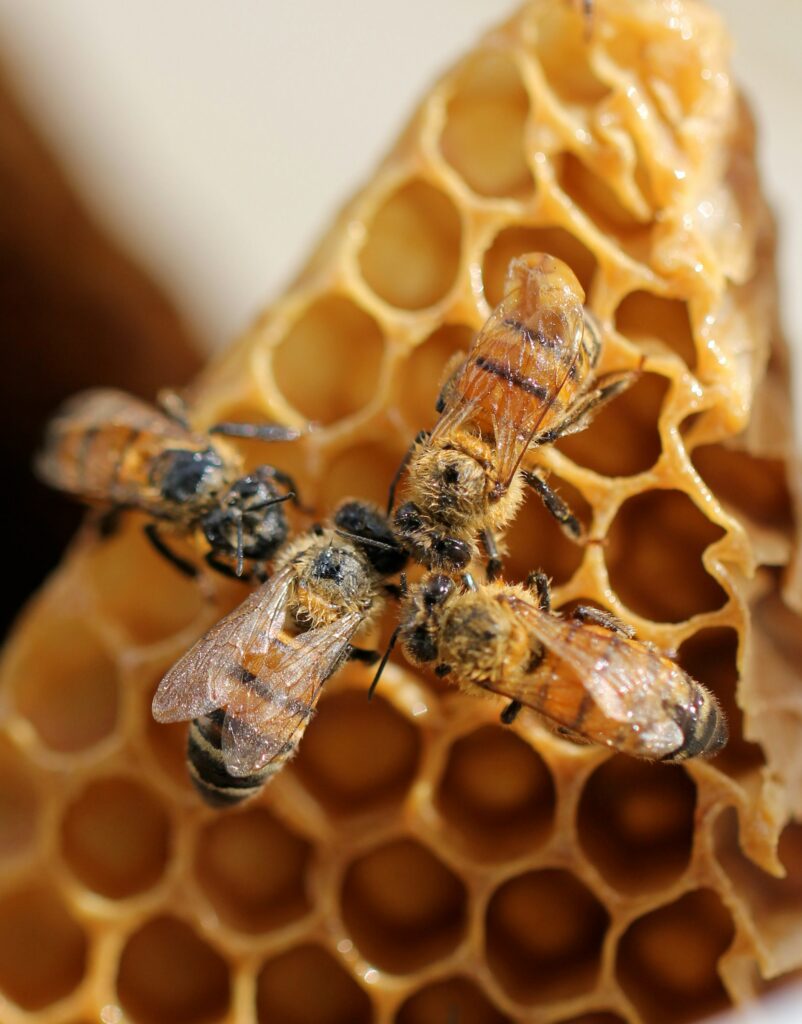
Africanized honey bees are slightly smaller than European honey bees, but the size difference is minimal and not something most people can reliably detect. They share the same golden-brown coloring with dark banding. Appearance alone should never be used to determine whether a colony is safe to approach.
Behavioral Differences
Behavior is where Africanized bees stand apart from European honey bees. If you notice any of the following, assume you are dealing with an Africanized colony:
- Highly defensive response to minimal disturbance, including nearby foot traffic or conversation
- Large numbers of bees mobilizing quickly to defend the colony
- Persistent pursuit of a threat over a quarter mile or more
- Agitation triggered by sounds and vibrations from lawnmowers, power tools, or generators
- Nesting in unusual locations: wall voids, utility boxes, flowerpots, fence posts, and similar structures
The “killer bee” reputation comes not from more potent venom, which is similar to a European honey bee, but from the volume of stings delivered during a defensive response. A disturbed Africanized colony may send hundreds or thousands of bees toward the perceived threat at once.
Why Africanized Bees Require Professional Removal
If you find a bee nest on your property in Phoenix, do not attempt to remove it yourself. This is not a situation where store-bought sprays, coverings, or DIY techniques are appropriate.
Africanized colonies can be triggered by activity that seems entirely unrelated to the nest. A lawnmower running 30 feet away, a dog moving through the yard, or even road vibrations can initiate a defensive response. When that response begins, it escalates rapidly.
For elderly individuals, young children, pets, or anyone with a bee allergy, a mass stinging event from an Africanized colony can be life-threatening. The safest course of action is to keep all people and animals away from the area and contact a licensed professional immediately.
What to Do If You Spot a Bee Nest in Phoenix
If you suspect an active bee nest on or near your property, follow these steps:
- Keep your distance. Do not approach the nest or allow others to do so. Mark the area if needed to warn neighbors.
- Do not disturb the colony. Avoid loud noise, vibrations, and any activity near the nest area.
- Keep children and pets indoors until the nest has been professionally addressed.
- Call Arizona Professional Bee Removal for same-day or emergency response throughout the Phoenix metro area.
If you or someone nearby is actively being stung, move quickly to an enclosed shelter such as a vehicle or building. Cover your head and face as you run. Do not attempt to hide in water. Contact Arizona Professional Bee Removal as soon as you are safely indoors.
Professional Africanized Bee Removal in Phoenix
Arizona Professional Bee Removal handles Africanized bee colonies throughout the Phoenix metro area, including Scottsdale, Tempe, Mesa, Chandler, Gilbert, Glendale, and surrounding communities. Learn about our bee removal services to understand how we approach each situation safely and effectively.
Our process involves identifying the colony, safely removing the bees using appropriate protective equipment and techniques, and, when bees have established inside a structure, extracting the honeycomb to prevent moisture damage, honey fermentation, structural decay, and re-infestation by other colonies.
We offer emergency bee removal for situations that cannot wait. If you have an active, agitated colony or a swarm near a high-traffic area, call us directly at (602) 456-5197. You can also visit our FAQ page for answers to common questions about bee removal timelines, costs, and what to expect during the process.
For a complete list of communities we serve, visit our service area page.
Ready to Solve Your Bee Problem?
Africanized bee colonies in Phoenix should always be treated as a priority. If you have a nest near entryways, AC units, children’s play areas, or high-traffic spots, do not wait. Contact Arizona Professional Bee Removal for same-day and emergency service throughout the Valley.
Frequently Asked Questions About Africanized Bees in Phoenix
Are all bees in Phoenix Africanized?
Not all bees in Phoenix are Africanized, but any wild or feral colony should be treated as if it could be. Managed colonies kept by local beekeepers are typically European honey bees, but wild swarms and established nests in structures are commonly Africanized throughout Maricopa County.
How do I know if I have an Africanized bee problem?
The most reliable indicator is behavior. If a colony responds aggressively to nearby activity, pursues a perceived threat over a long distance, or mobilizes a large number of bees quickly, Africanized behavior is likely. The only reliable way to confirm is through laboratory testing, which is why professional evaluation is always recommended.
Can Africanized bees be relocated instead of exterminated?
In many cases, yes. Arizona Professional Bee Removal prioritizes live removal and relocation when conditions allow. Whether relocation is possible depends on the location, size, and accessibility of the colony, as well as the risk level of the removal environment.
How long does Africanized bee removal take?
Most accessible swarm removals can be completed in one to two hours. Structural removals, where a colony has established inside a wall, eave, or ceiling, take longer and may require opening the structure to fully extract the hive and all honeycomb.
What happens if I leave an Africanized bee nest alone?
An established colony left in place will grow. As the colony expands, the defensive perimeter and the risk level both increase. A colony that seemed manageable in spring can pose a serious hazard by summer. Additionally, honeycomb left inside a structure attracts other pests and can cause significant structural damage as wax and honey break down in Arizona’s heat.
